
HIGH VALLEYS OBSERVATORY · VISUAL ETHICS & REPUTATION · ARTIFICIAL INTELLIGENCE
Mountains That Do Not Exist
AI-generated imagery is inexpensive and produced in minutes. For those communicating an alpine territory, however, it risks costing the hardest asset to rebuild: trust.
A.V.I. Presse · High Valleys Observatory
Visual Ethics, Alpine Brands & Trust
5 minutes (~1,150 words)
Documentary Realism vs Synthetic Averages
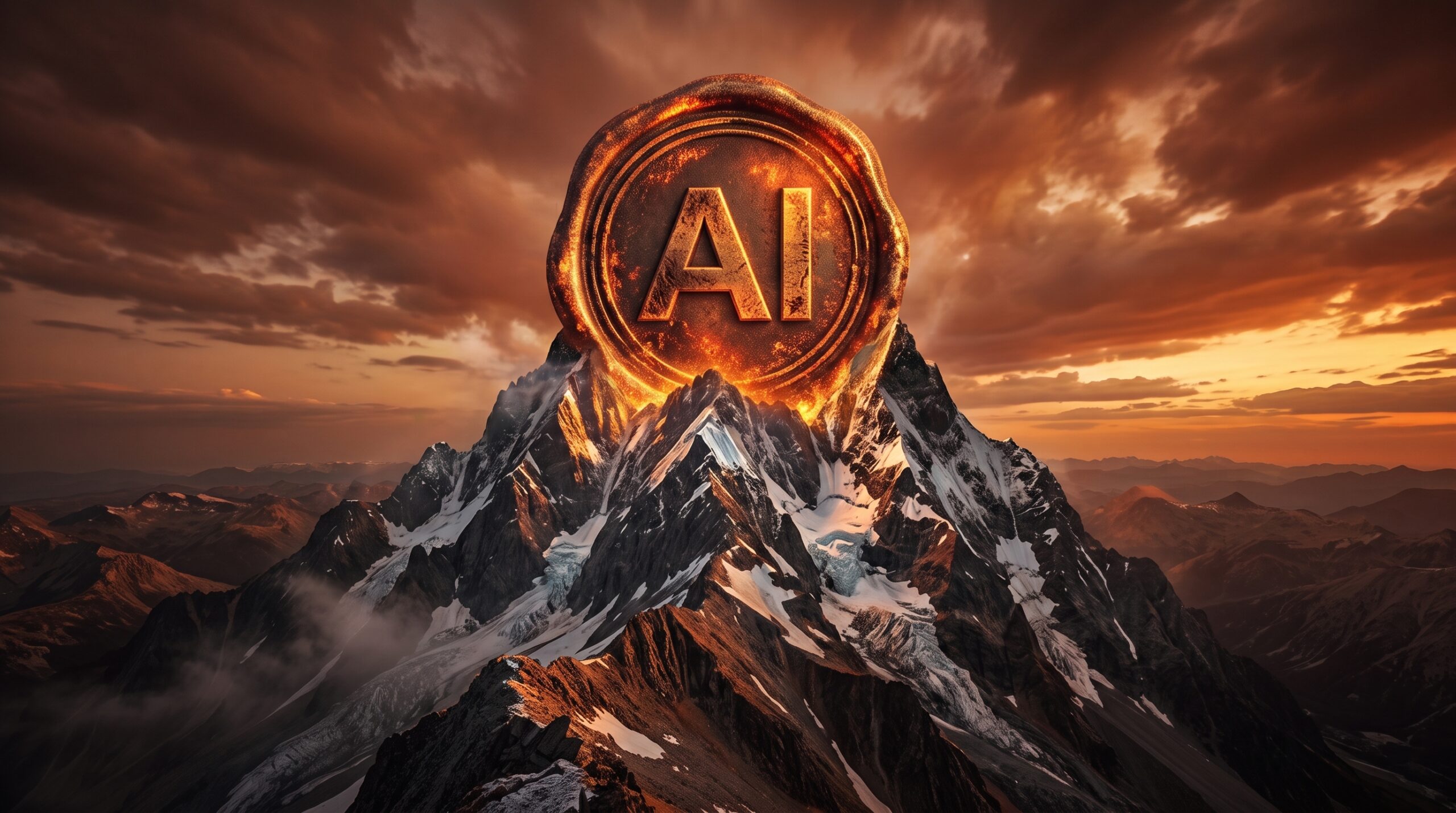
Open the website of an alpine hospitality business and you see an immaculate summit, a cloudless sky, and a smiling couple on a pristine trail. Everything looks pleasant and everything feels vaguely inaccurate. You cannot pinpoint where that photo was taken, because it was taken nowhere.
In recent years, synthetic images generated by artificial intelligence have entered public communication. They are fast and low-cost. They require neither film permits nor production days on location. The real issue is what they strip away.
An Unspecified Mountain
Ask an image generator for "an alpine valley at sunset" and you receive a plausible valley. It could be in Switzerland, the Himalayas, or the Rocky Mountains. It will rarely be the Val d'Ayas.
This is not an error solved with a more detailed prompt. These tools learned from millions of photographs and tend to return the most probable combination of what they have observed. The result is the statistical average of a mountain, not that specific mountain.
For a regional territory, the mathematical average is the opposite of what matters. Those who choose one valley over another do so for its unique traits: the contour of a ridge, the color of local stone, the village fountain. These are precisely the physical details a statistical model smooths out.
Those Who Know the Mountain Notice
The audience of an alpine hotel or a mountain manufacturer is not distracted. Often they are people who have returned to that valley for years, know the hiking trails, and understand how natural light hits a slope in February.
Rock that resembles plastic, overly uniform snow, a chalet with impossible structural proportions are quickly noticed. Sometimes unconsciously: viewers sense that something is off, without being able to define what. That unsettling impression sticks to the brand.
There is also an even sharper audience: local residents. For a business operating in a mountain village, being recognized by neighbors as serious and rooted carries the weight of a major advertising campaign. Presenting one's home using an image of a place that does not exist sends a message difficult to justify.
Nor is this merely about aesthetics. Promising a specific view, a mountain shelter, or a product with an unauthentic image generates an expectation verified on arrival. In that scenario, customer disappointment cannot be refunded.
The Value of Physical Imperfections
We call our working method "Documentary Realism" and it begins with a clear premise: the real mountain is rougher than catalog prints. There is mud on leather boots, morning vapor in the breath, timber weathered by decades. There is low-angle sunlight leaving half the frame in shadow.
These physical imperfections should not be removed in post-production. They prove that human operators stood on location. Viewers recognize this instinctively.
A close-up shot of hands working aged timber or a wheel of Fontina cheese turned in a stone cellar conveys more than an idealized panoramic view. It documents who you are, what you produce, and where. It is an image an algorithm can imitate, but can never document.
A Proprietary Archive, Not a Monthly Subscription
A generated graphic is used and discarded. A photograph or film reel captured on your home territory enters an archive that belongs to you, grows each season, and gains commercial and civic value.
This difference proves critical in three key scenarios:
- On social channels, where authentic, continuous documentation builds durable recognition
- At trade fairs, industry summits, and civic events, where large-scale projection exposes every visual artifact
- With news media and press outlets.
The third point is frequently overlooked. Many newsrooms wish to report on a mountain territory but lack the editorial budget, time, or crew to dispatch on-site. If they receive genuine, high-resolution documentation with clear usage rights, the story runs. An AI-generated rendering cannot be published as factual documentation of a geographic place.
We know this firsthand. Our archive holds forty years of professional footage recorded across the Aosta Valley, fully digitized. Sequences filmed decades ago prove invaluable today to document how a village, an artisan trade, or a glacier has evolved. No algorithmic model can reconstruct what was never documented.
Three Checks Before Publishing
Before using an image to represent your territory, consider three questions:
- Would someone familiar with this location recognize it?
- If a visitor arrived here tomorrow, would they encounter what they saw?
- Could you submit this file to a journalist as factual documentation?
If any answer is no, that image is eroding your credibility.